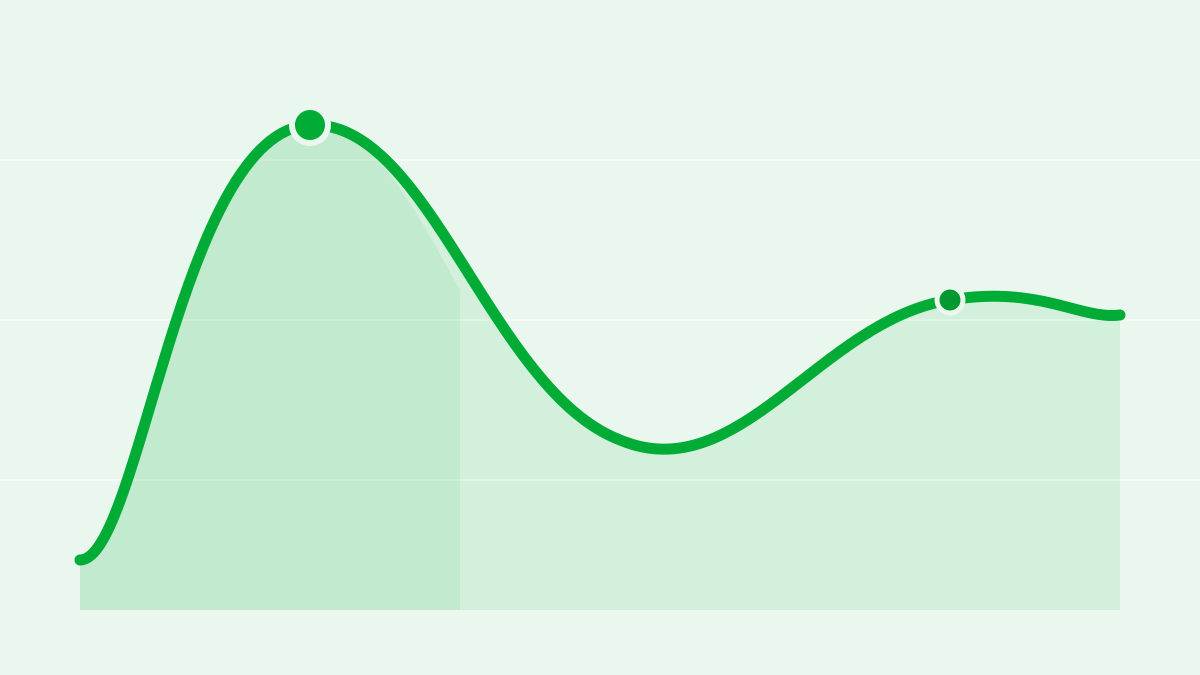
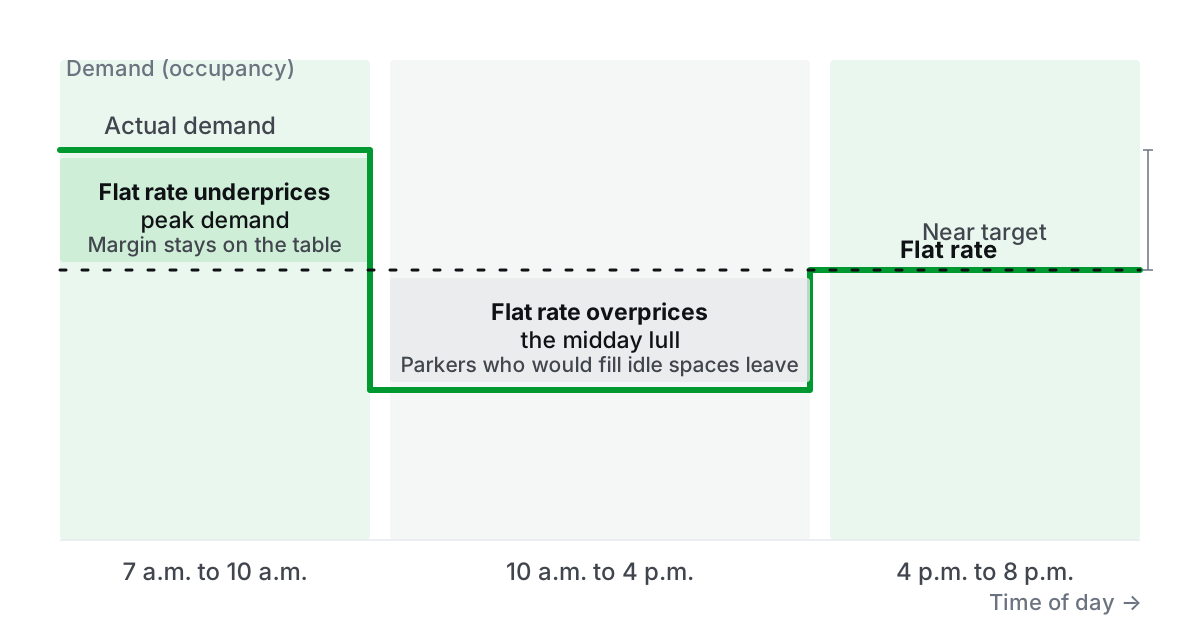
A flat hourly parking rate makes the same error twice a day: it underprices the morning arrival window, then overprices the midday lull. Both happen at the same lot, on the same day, every weekday. Neither requires an algorithm to fix.
The mechanism is straightforward. When demand peaks, your lot fills regardless of what you charge. That signals the rate could be higher: parkers are arriving anyway, and availability is the constraint. When demand falls, the same rate that held through the morning keeps some parkers from entering at all. You are charging more than they are willing to pay for an arrival that would fill an otherwise idle space.
Those two conditions run simultaneously, on opposite ends of the same clock. A flat rate treats them as the same product.
How the programs that published their data structured rates
The two demand-based parking pricing programs with the most rigorous public evaluations both treated time of day as the foundational structure, not a secondary variable.
San Francisco's SFpark set meter rates in three time-of-day increments, adjusted block by block, targeting a 60 to 80 percent occupancy band. Source: FHWA, Contemporary Approaches to Parking Pricing The rate for a given block at 8 a.m. could differ from the rate at noon and from the rate at 4 p.m. Time slot came first; the feedback loop that adjusted those time-slot rates came second.
Los Angeles ran the same logic under a different name. LA Express Park, launched in downtown Los Angeles in 2012 and later expanded to Westwood, Hollywood, and Venice, set rates in morning, midday, and evening blocks. Source: LADOT, LA Express Park Intelligent Parking Management project fact sheet The goal was to hold occupancy between 70 and 90 percent on each block. Rates varied by slot; occupancy data told the program whether those rates were calibrated correctly.
Neither program treated time-of-day differentiation as a refinement layered on top of demand-based pricing. It was the primary architecture. Demand feedback was the correction mechanism.
What happened when those rates were measured
When the Los Angeles Department of Transportation analyzed the first year of LA Express Park rate adjustments, the distribution was not what most operators would expect: rates decreased at 59 percent of meters, increased at 29 percent, and held unchanged at 12 percent. The average rate fell 11 percent across all meters in the program. Source: LADOT interdepartmental correspondence, January 2024
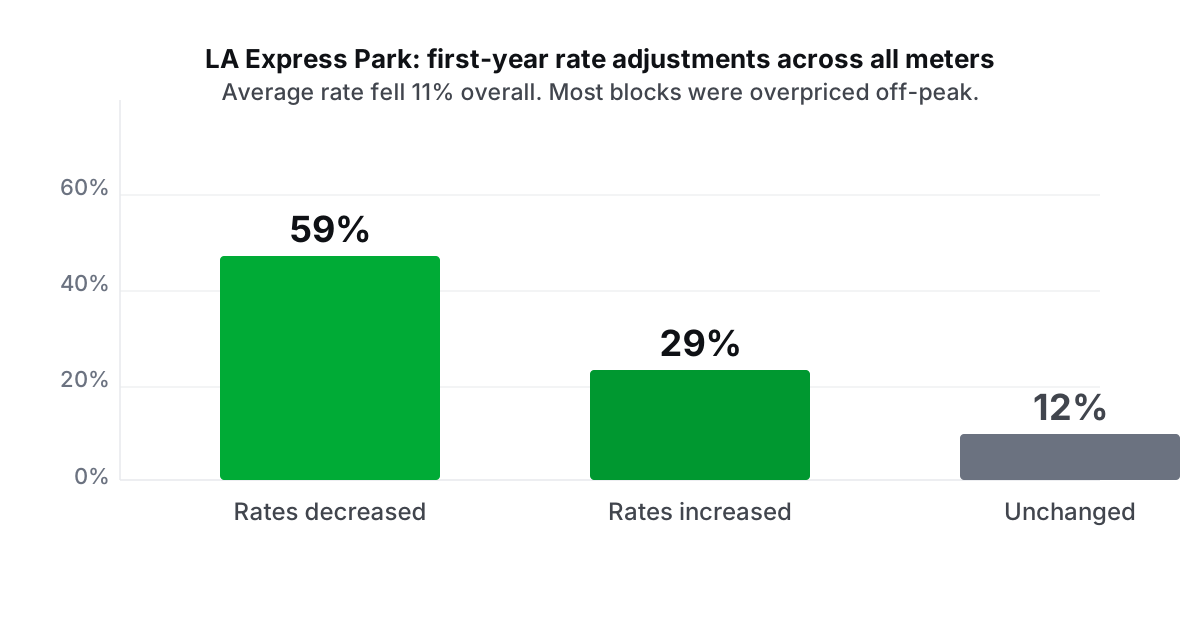
That result is counterintuitive if you assume demand-based pricing means higher prices. What it actually reflects is the starting condition of any flat-rate system: many blocks were overpriced relative to the occupancy target, particularly during off-peak windows. The system corrected downward on those blocks and upward on the ones running above 90 percent. The rate cuts outnumbered the rate increases because the flat rate, set to capture peak demand, was too high for the rest of the day.
A separate U.S. Department of Transportation evaluation found that LA Express Park produced a 37 percent reduction in parking duration across downtown. Source: ITS Knowledge Resources, 2024-b01821 When off-peak prices fall, some extended parkers shift to shorter stays, which releases inventory during the hours when availability was otherwise constrained. Duration is the hidden lever in any time-block system.
SFpark produced a related pattern: average meter rates fell 4 percent while average parking search time dropped 43 percent in pilot areas and cruising declined by more than 30 percent. Source: ACCESS Magazine, UCLA researchers Gregory Pierce and Donald Shoup, 2013 The headline from both programs is consistent: lower average rates, better availability, and a distribution of rate changes that corrected overpricing in slow windows while recovering margin in the busy ones.
The commercial parallel
Hotels moved from complimentary or bundled parking to managed, tiered parking over the five years between 2019 and 2023. The results are in CBRE's Trends in the Hotel Industry database, which tracked 1,178 properties across that period.
Parking revenues at those hotels grew 23.1 percent from 2019 to 2023, more than four times the rate of total hotel revenue growth. Source: CBRE, As Occupancy Stalls, Parking Drives Hotel Revenue Growth The share of hotels reporting parking revenue at all rose from 17.0 to 22.3 percent. Parking department profit margins reached 61.3 percent of department revenue in 2023, higher than the average for all other operated departments at those properties.
None of that came from building new garages. It came from treating parking as a managed product with differentiated pricing: higher rates for valet versus self-park, different rates for event nights versus standard nights, separate rates for overnight versus transient day parkers.
Hotels already priced rooms by arrival date, length of stay, and demand level. Applying the same logic to the garage was not a new idea. What changed was that operators started doing it systematically rather than leaving the garage on a single posted rate while the room rate engine ran upstairs.
A commercial parking operator running a flat hourly rate across the full day is in the same position as a hotel that charges an identical room rate on a sold-out Saturday and an empty Tuesday. The math is the same. Only the product is different.
What a private operator can do without sensors
You do not need occupancy sensors to identify your peak window. You need a count.
Two weekdays and one Saturday, thirty-minute intervals, from opening to close. Write down how many cars are in the lot at each interval. The peak is visible: it is almost always a two-to-three hour window, almost always in the morning on weekdays, and almost always in the evening on Saturdays. That count is the demand signal.
From that count, two questions follow.
The first: what is the highest rate the peak window will sustain? If your lot runs above 90 percent occupancy in that window, the rate could be higher. The demand is there; availability is the constraint. A rate increase limited to that window tests whether parkers are price-sensitive in a period when they are choosing between your lot and circling. In most commercial locations, they are not particularly price-sensitive during the peak, because the alternatives are limited and the arrival timing is not flexible.
The second: what rate brings in parkers during the midday? At low midday occupancy, a lower rate is worth testing. The parkers you gain in the lull are incremental revenue. The discount is the acquisition cost for customers who would not have parked at the full rate. An off-peak rate available only during specific hours is not a price cut on your product; it is a separate product for a customer with different demand characteristics.
The New York City Department of Transportation has applied this same logic to on-street meters in dense neighborhoods. In Park Slope, metered parking runs at $2.00 per hour during peak hours (noon to 7 p.m.) and $1.00 per hour off-peak. Source: FHWA, Contemporary Approaches to Parking Pricing The ratio is the mechanism: identify the windows where demand is reliably high and low, set rates that reflect that difference, and measure the result.
Running it as a schedule, not an algorithm
The appeal of time-block pricing is that it does not require a feedback system to start. It requires identifying your lot's intraday demand shape, which a manual count confirms, and publishing a rate schedule with two or three time slots.
The programs in San Francisco and Los Angeles used occupancy sensors to refine their time-slot rates over successive adjustment cycles. A private operator without sensors can accomplish the same refinement manually: if the peak window fills faster than before your rate change, the premium is working; if midday utilization improves, the off-peak incentive is working. The measurement is slower, but the structure is identical.
What does not work is treating a time-differentiated schedule as a one-time setting. The demand pattern that makes your morning peak predictable also shifts: a new employer in the neighborhood changes commuter flow, a restaurant closure changes evening patterns. A rate schedule reviewed twice a year against a manual count will stay calibrated; one set once and left alone will drift.
The same errors the flat rate makes on any given day, the unreviewed time-block schedule will make over years. The advantage is that when you review the schedule, the count tells you which direction to move.
Level Parking builds and operates parking facilities directly, including the pricing and access systems that run on them. Our data from operated properties informs how we think about rate structure for owners and operators.