The rate you charge today was set at some point in the past, adjusted rarely since, and has since become a fixture of your operation — a number everyone knows and nobody questions. That's a hypothesis you've stopped testing. In parking, an untested hypothesis means charging too little when demand peaks and too much when inventory sits empty — sometimes on the same lot, on the same day.
The flat-rate blind spot
A flat rate is the simplest way to operate a parking facility. It also hides the most useful signal your lot produces: whether the price you're charging reflects the demand that's actually showing up.
At capacity — when every space is full and drivers are circling — a flat rate underprices your inventory. The demand is there. You're not capturing it. At low occupancy — when a third of your spaces sit empty on a Tuesday afternoon — a flat rate may be the reason demand is thin: a lower price might fill those spaces, and the revenue on additional parkers exceeds the modest discount you extended to get them.
Both conditions exist on most lots across a single week. A flat rate treats them identically.
The math is asymmetric: an overpriced off-peak hour costs you transactions. An underpriced peak hour costs you margin on every car that parks anyway. A flat rate that smooths across those two conditions is not neutral — it's guaranteed to get at least one of them wrong, and usually both.
What demand-responsive pricing actually does
Demand-responsive parking pricing isn't surge pricing. The distinction matters.
Surge pricing — the model most associated with ride-hailing — applies multipliers in real time based on current conditions, with no floor and no preview. The price can spike sharply and unpredictably. That model's reputation is well-earned, and it's not what a well-run parking pricing system looks like.
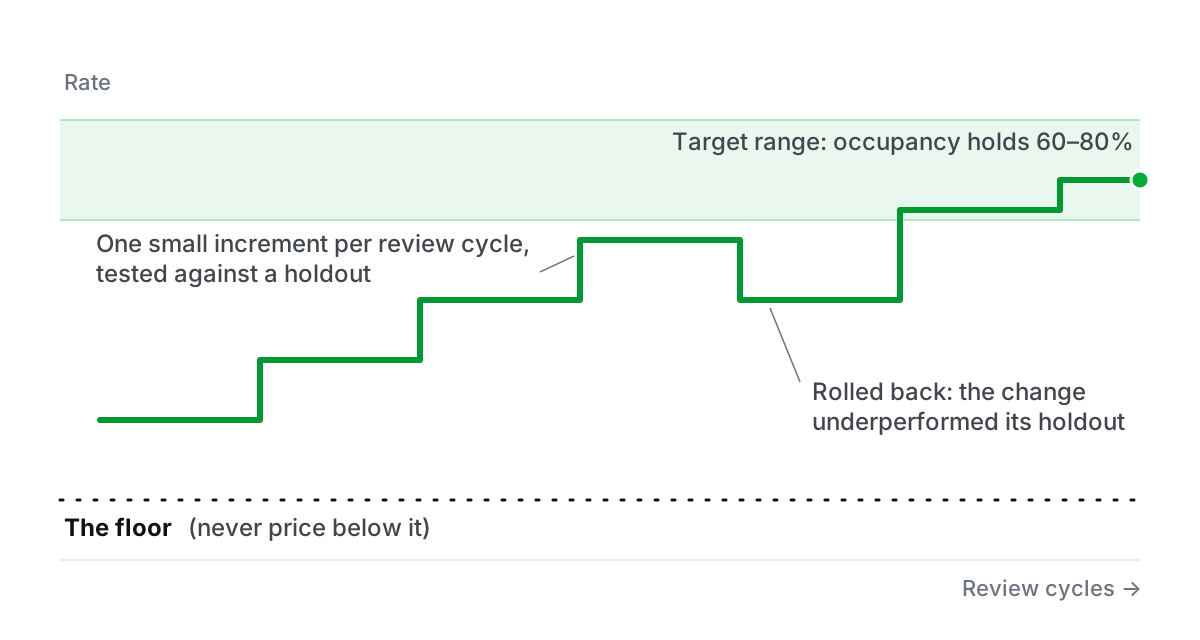
A demand-responsive parking rate is structured around three components: a floor, a target occupancy range, and a measured adjustment increment. The floor is the minimum price — the level below which you won't go regardless of what the occupancy model says, because that's the rate that covers your operating economics. The target range — typically 60–80% occupancy — is the band where availability and revenue are in balance: full enough that you're capturing demand, not so full that parkers can't find a space. The adjustment increment is the amount prices move per review cycle, tested against a control group so you know whether a change is working before you extend it broadly.
That structure is what separates pricing from guessing.
What the evidence shows
San Francisco's SFpark program is the most rigorously evaluated demand-based parking system deployed in the U.S. at scale. Run across seven neighborhoods with over 7,000 metered curbside spaces and 12,250 garage spaces, it used the same architecture: raise prices on blocks above 80% occupancy, lower them on blocks below 60%, hold steady in the target band.
The SFMTA's evaluation after two years found:
- Average parking search times dropped by 5 minutes — a 43% reduction — in pilot areas
- Cruising for parking fell by more than 50%
- Blocks were at full capacity 16% less often
- The target occupancy range was met 31% more often
- Meter-related citations decreased 23%
- Average on-street meter rates actually fell by $0.11/hour (4%) — the system lowered prices in underutilized blocks and raised them in overutilized ones, and drivers paid less on average while availability improved
The revenue held and improved. Drivers found spaces faster. The same inventory, better allocated.
The academic follow-up matters as much as the headline numbers. When UCLA researchers Gregory Pierce and Donald Shoup analyzed 5,294 individual SFpark price changes, they found an average price elasticity of about −0.4 — a 10% rate increase corresponded to roughly a 4% drop in occupancy — with what they called "astonishing variety" from block to block. Source: ACCESS Magazine The same rate change that balances one block does nothing on the next. That is the strongest argument for measuring your own property instead of borrowing an average: the response to a price change is local, and the only way to know yours is to test it.
Seattle drew the institutional conclusion. Its performance-based parking pricing program has set on-street rates using occupancy data since 2010 — roughly 11,500 paid spaces managed against a 70–85% occupancy target, with rates reviewed on a recurring data-driven cycle and adjusted where blocks run persistently over or under the band. Demand-responsive pricing there isn't a pilot. It's how the city has priced the curb for fifteen years.
Both are public curbside programs — which is exactly why their data is published and independently evaluated. The mechanics they validated — a floor, a target band, small measured increments — transfer directly to private surface lots and garages. The difference is that private operators rarely publish their results.
The event case: demand you can see coming
The clearest argument for demand-responsive pricing isn't a typical Tuesday. It's the Friday night with a game or a concert within walking distance.
Demand signals for events are visible well in advance. Ticket sales, venue calendars, hotel booking data: the information that the lot will fill is available days or weeks before the date. Yet operators within walking distance of arenas and theaters frequently charge the same rate on a playoff night as on a weekday, leaving the most predictable demand surge in their business calendar unpriced.
A sold-out venue changes the demand curve for every lot within walking distance, and it does so on a schedule published months in advance. A flat rate on those dates is a missed opportunity on every date it happens. The parkers are coming regardless. The question is whether the rate captures the value.
Event-tier pricing — a planned rate for high-demand dates, published in advance so drivers know what they're getting into — is the simplest form of demand-responsive pricing to implement and defend. It's not a surprise. It's not a spike. It's a posted price on a date when anyone familiar with the neighborhood already knows the lot will fill.
Running it as a discipline, not a setting
None of this is set-and-forget. That's the most important thing to understand about dynamic pricing as an operator.
A rate algorithm without someone accountable for the results is not a pricing strategy — it's a fee schedule with a confidence problem. What makes demand-responsive pricing work is the discipline behind it: occupancy data reviewed on a defined cycle, rate adjustments tested against control groups, rollbacks when a change underperforms, and a floor that protects minimum revenue regardless of model output.
The SFpark program ran adjustment cycles every few months, moving rates one small increment at a time and measuring the response before moving again.
This is also how we run pricing at Level Parking. On the lots we operate, a rate change ships as an experiment: a floor that doesn't move, a target occupancy band, and a holdout — comparable inventory left at the old rate — so the change is measured against a control instead of a feeling. Changes that underperform their holdout get rolled back. We built the software that runs this loop because we operate the lots it runs on; the discipline came first, the tooling second.
For a property owner, that's the right frame: demand-responsive pricing is a measurement practice that produces better rates as an output. The rates are the result. The measurement is the work.
The hypothesis you haven't tested
Most operators have never run a controlled test on their parking rate. They've raised prices when revenue felt low, left them alone when occupancy felt adequate, and anchored to the rate competitors charge without measuring whether it reflects local demand.
That's not a pricing strategy. It's a series of untested assumptions compounding over time.
A rate is a hypothesis: this price reflects what my market will pay at this time of day, on this day of the week, given this level of demand. A hypothesis without a test is just a belief. The evidence from the programs that publish their data is consistent: testing rates against a control group, targeting an occupancy range instead of maximizing occupancy, and maintaining a floor produces more revenue and better availability than a flat rate held constant does.
Not every property responds the same way — the block-by-block SFpark data shows exactly that. Not every experiment runs cleanly. But the gap between an untested flat rate and a measured, floor-anchored, demand-responsive rate is almost always revenue that's been sitting on the table, waiting for someone to run the test.