The commercial curb has never had good data. Operators knew loading zones were contested: they received tenant complaints, watched drivers circle, noticed access lanes blocked at predictable hours. What was missing was evidence that a different approach worked, measured at a scale that translates to a property management decision. That data now exists.
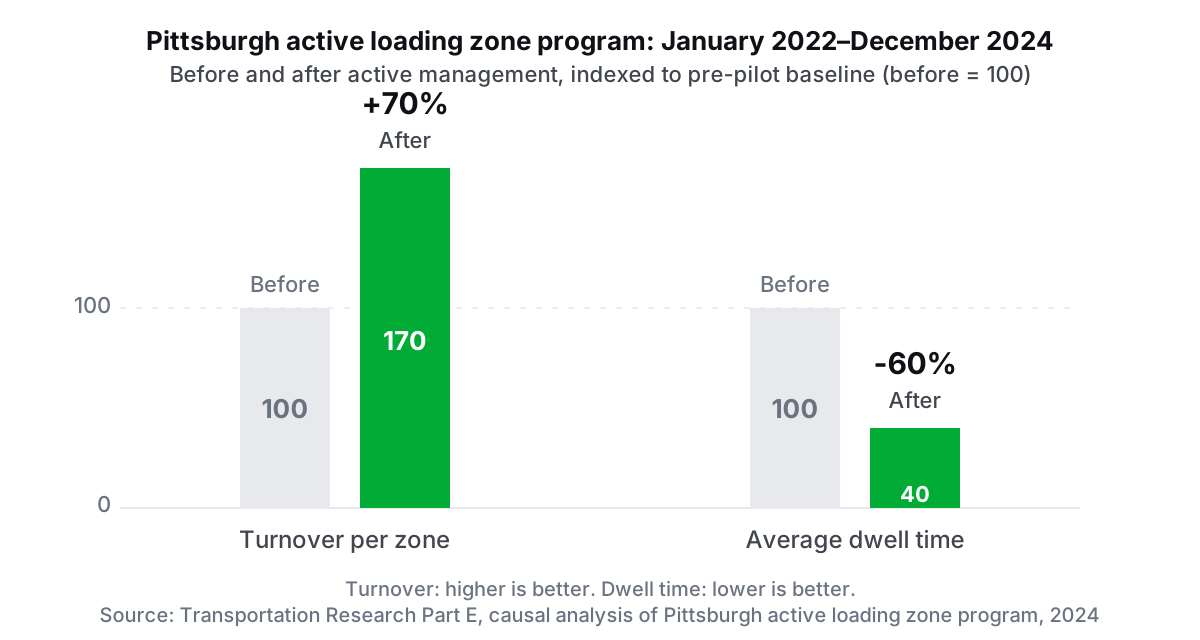
From January 2022 through December 2024, Pittsburgh's Department of Mobility and Infrastructure ran an active loading zone program across 20 zones in the downtown core. A causal analysis published in Transportation Research Part E measured the results: vehicle turnover increased 70% per zone, and average park durations fell 60%. The same pavement, managed with time limits and camera-based monitoring, served substantially more vehicles without adding a single space.
That is the evidence. The question is what property operators do with it.
Why the unmanaged zone underperforms
Delivery volume has outgrown the infrastructure designed to hold it. Urban freight now accounts for 30–50% of urban road congestion, according to The Geography of Transport Systems. When legal loading space fills, drivers adapt: a 2023 peer-reviewed study found that 60% of delivery drivers resort to illegal parking when legal spots are unavailable. The behavior is not negligence. It reflects a straightforward calculation: the fine is predictable, the delay is not.
The unmanaged loading zone compounds this. A space with no time limit and no enforcement defaults to whoever arrives first and stays longest. That is often a larger vehicle completing a complex delivery, one that occupies a zone for 90 minutes while several shorter deliveries queue in the travel lane. The zone is not "in use." It is occupied. The difference matters.
Shorter dwell times, repeated across dozens of arrivals per day, multiply how many deliveries a zone can handle. That is the mechanism behind Pittsburgh's results: time limits shifted occupancy from single long events to repeated short ones, and total throughput increased substantially.
What the pilots measured
Pittsburgh's program is the most rigorously documented, but it is not isolated. Federal investment in commercial curb management has accelerated across multiple cities, and each program has produced evidence that the unmanaged curb is not a baseline; it is a sub-optimal one.
The U.S. Department of Transportation has funded dedicated curb work through its SMART grant program. Los Angeles DOT received a $2 million grant to create a digital inventory of loading zones across downtown LA. Denver received $250,000 to build a machine-readable map of its curb areas, including signage, parking zones, and pricing data. Seattle and Minneapolis together received a $15 million Stage 2 grant in December 2024 to scale their commercial vehicle permitting and curb management programs.
The common thread in each of these programs is not enforcement technology. It is documentation: defining what each piece of curb is for, who may use it, and during which windows. That documentation is the prerequisite for everything else.
The data layer cities are building
The digital infrastructure behind these pilots now has a standard. The Open Mobility Foundation's Curb Data Specification (CDS) provides a format for describing curb zones in machine-readable terms: what space exists, when it is available, for which vehicle types, and at what price. Version 1.1, released in November 2025, added real-time event reporting and multi-format payment tracking. More than two dozen cities and companies have adopted CDS since version 1.0 launched in 2022, including Seattle, San Francisco, Los Angeles, Pittsburgh, Miami, Minneapolis, and Washington DC.
The practical implication: delivery fleet routing systems can be given a machine-readable map of available, legal commercial loading space in a city and route drivers accordingly, rather than leaving them to improvise on the block.
Private operators' loading zones are not in that map. Most private commercial loading space has no published rules, no documented availability windows, and no integration with any routing or coordination system. That absence is not a compliance problem. It is an unacknowledged opportunity.
What spillover means in practice
Cities are moving toward pricing commercial curb access, not just regulating it. California's SB 1292 authorizes six California cities to deploy automated cameras that charge fees for loading zone access. When public loading space becomes both priced and enforced, delivery operators change how they plan their routes.
A predictable private loading zone (posted rules, consistent availability, no ambiguity about fit or occupancy) becomes an attractive alternative to priced public space. This shifts the competitive position: well-managed private loading zones are not competing with free, contested public space. They are competing with priced, unpredictable public space. That is a meaningfully different market.
What managed loading zones actually require
Pittsburgh's program did not require significant infrastructure investment. It required defining what the zones were for, making the rules visible, and tracking occupancy. The same three elements apply to private loading space on any commercial property.
Defined commercial windows. Post specific hours during which the zone is reserved for commercial deliveries, matched to tenants' receiving hours, and communicate them to the logistics operators serving those tenants. Carriers comply with clear, consistent windows because predictability benefits their route planning. One that does not know a window exists will arrive whenever a dispatcher allows and stay as long as the delivery requires.
Posted time limits. Pittsburgh's 60% reduction in average dwell came from this mechanism. A maximum dwell, prominently posted at the zone entry, shifts vehicle behavior without requiring active enforcement of every event. Overstays become visible exceptions rather than the default operating mode.
Plate-based occupancy monitoring. The cameras already handling access control or parking enforcement on most commercial properties can log commercial loading zone occupancy and flag overstays. Without occupancy data, management is reactive and complaint-driven. With it, patterns become visible: which tenants receive the longest-dwelling deliveries, which windows are underused, and where a second designated zone might relieve pressure.
Tenant coordination. Most logistics operators already manage delivery windows for tenants who request them. The coordination cost for carriers is low. It is only absent at properties that have not established or communicated a policy. Operators who set clear commercial loading rules give tenants something specific to pass to their carriers, and carriers treat those properties differently.
The through-line
Three years of documented city programs produced a consistent finding: the commercial curb performs substantially better when it has defined rules, enforced time limits, and occupancy visibility. Pittsburgh's 70% turnover increase and 60% shorter average dwell are not anomalies. They reflect how any queuing resource behaves when managed versus when left to self-sort.
Most private loading zones are operating without any of these mechanisms. The infrastructure is already in place: a physical zone, access, and often cameras already pointed at the relevant area. What is missing is the decision to treat commercial loading space as a managed resource with defined rules, rather than as an overflow area without them.
The Pittsburgh data answers whether active loading zone management works. What remains is a property management question: whether the operator treats commercial loading space as an inventory item or as an afterthought.